
This post is about one job search campaign, which went as follows: 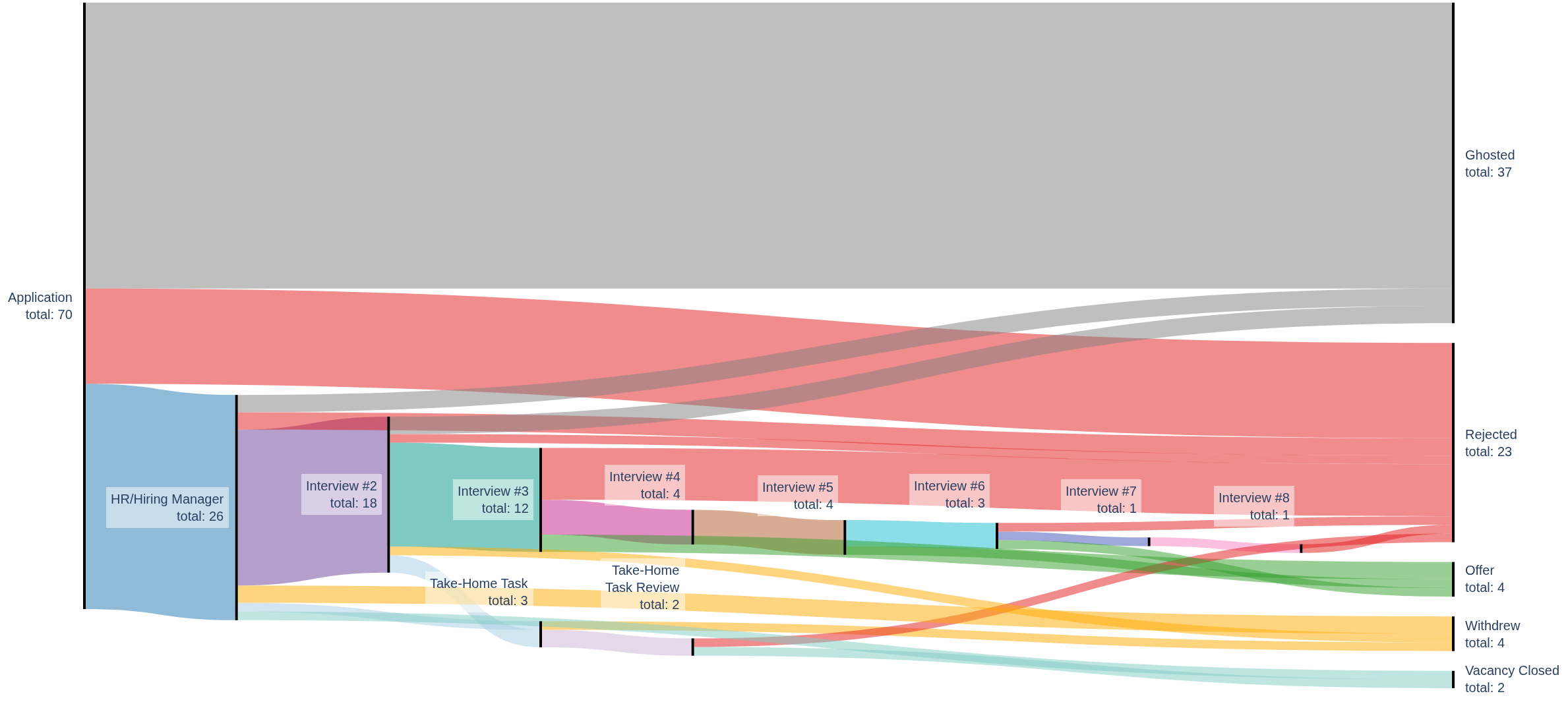 The diagram captures outcomes roughly, and the remaining text expands with analyses and reflections.
Outline
Never did I ever search for a new role in the same 'high and low' manner as in summer of 2026. My usual pattern previously was:
- apply to a handful of places,
- go through a single process to the end,
- accept the offer.
That isn't to say that the old pattern was optimal; but it served the purpose when I was seeking employments in my native market. However, when one's career takes an international bend, there is a certain sense of reset where past achievements in the country N are discounted by hirers in the country M. London being my 3rd job market within the span of 5 years, enough resets accumulated that I felt the need to prioritize the breadth (of job search) over its ease.
Industries
The breadth ensued from applying for a wider range of roles, than what I would've normally considered - besides autonomous vehicles, where my standing is the most established, I included all the domains, where I had any exposure within the last decade: Robotics, AI, VR, Computer Vision. And the strategy did work (to an extent), as I have got offers outside my specialty area; although, it worked not without limitations: the initial conversion (from my application to a first HR interview) was much lower for me outside the self-driving industry, and depended heavily on my finding a recommender within the target org. More on it below:
| Industry | Conversion | Conversion with recommendation |
|---|---|---|
| Autonomous Vehicles | 0.7 | 0.67 |
| AI | 0.25 | 0.67 |
| Robotics | 0.47 | N/A |
| CV | 0.38 | 1.0 |
| VR | 0.4 | 0.0 |
| across all | 0.36 | 0.6 |
Organisation Types
This split I cannot tabulate as I did for the industries, but generally it was easier to get an interview in startups or scale-ups, much harder in Big-Tech companies or their spin-offs (Waymo, Isomorphic, Meta, Amazon), and extreamly hard in large, public consumer electronics companies (Samsung, Huawei, Fujitsu, Apple, NVIDIA), even for those among them, where I used to work before!
General Vibes
I was generally impressed with overall level of dialogue and interviewing in the most of organisations I've interacted with. The proverbial "smartest person in the room" in many-many cases was not me, but my counterpart when it came to the technical screenings and interviews. I hope to not forget these peoples' names and to meet them again at conferences and professional events in the city and to talk more.
Another surprise is that very often there are 3, not 2 parties to the hiring process in the UK: a candidate, a company, and a headhunter. This sometimes feels excessive, but also sometimes works incredibly, and I can't imagine how tough and stressful the headhunter's job is. While being on the market, I've chatted with several fellow candidates who tried to automate their candidate-headhunter interactions via agents; I don't see however how this could be done sustainably.
Just to mention a surprise more: some orgs still use take-home assignments in their interview process. Other orgs include "agentic coding" interviews; the latter ones were invariably dull - not once (unfortunately) did I get schooled on how to leverage an agent better.
I was dumbfounded to find out that one job type I was looking forward to inverview in virtually went extinct, and, I believe, not because of LLMs. The "industrial" side of SLAM technologies seems to have reached convergence: few companies that sell SLAM as a product b2b aren't hiring, and the new orgs building in-house don't separate SLAM organisationally as much as they used to. Sometimes CV and AI roles do mention it, but only at 4th, or 5th line in the requirements list, SLAM not being at the heart of the vacancy advertised.
Tips for future self
/or for anyone who cares to read it/ I don't have much to add on offer negotiating; although these posts are just gold. This time, in all likelihood, I did overdo it in terms of breadth, and included too many domains/industries in my search. This choice did complicate the preparation (and affected the overall conversion rate), as the companies, even from adjacent domains, ask very different things in their interviews.
All in all, it was a massive step outside the comfort zone, and I do believe that I am better off for it. And what else Londonmaxxing is supposed to be about?